Protein claims are showing up across more categories than ever. Consumers are actively seeking higher-protein options, while manufacturers are working with a wider range of protein sources to meet demand. But choosing a protein is only part of the formulation challenge. The source can have a major impact on taste, texture, processing and the overall consumer experience.
The Protein Push
Protein is no longer limited to traditional shakes and bars. High-protein positioning is moving across the store, from everyday staples to indulgent products.
Beverages: Protein is moving into ready-to-drink beverages, clear drinks, coffees and even carbonated formats.
Snacks: Protein is showing up in chips, puffs, crackers and other savory snack formats.
Bakery & Cereal: Bars, breads, baked goods and cereals are using protein to add nutritional value without changing the familiar format.
Dairy & Frozen: Yogurt, ice cream and other dairy-based products are being reformulated around higher-protein positioning.
Confectionery: Protein is finding its way into indulgent formats such as candy, chocolate and better-for-you treats.
Hydration & Wellness: Protein is increasingly being paired with hydration, energy and other functional benefits in convenient formats.
The demand is putting pressure on traditional protein sources as well. Whey remains a benchmark, but supply constraints and rising costs are pushing developers to consider alternatives including pea, fava, egg and other protein sources. Which protein you use has become a sourcing decision as well as a formulation and flavor decision.
Picking the Right Protein
Animal proteins — Whey, casein, egg, collagen and aquatic proteins are among the options available to formulators.
Pros: Strong familiarity, established functionality and, depending on the source, good solubility, texture or nutritional positioning.
Cons: Can bring dairy, egg or other characteristic notes; some sources can be more challenging from a cost, allergen, sustainability or consumer-preference standpoint.
Plant proteins — Soy, pea, fava, rice, canola, sunflower, lentil, mung and other plant proteins are giving developers more options than ever.
Pros: Broad sourcing options, strong plant-based positioning and flexibility across beverages, bars, bakery, snacks and other formats.
Cons: Many can introduce beany, earthy, grassy, bitter, astringent or cardboard-like notes that need to be considered during flavor development.
Fermentation-derived proteins — Precision fermentation can produce specific proteins using microorganisms, while biomass fermentation can create protein ingredients from organisms such as fungi, yeast, bacteria or algae.
Pros: Creates new formulation possibilities and can provide proteins with targeted functionality or animal-protein-like characteristics without relying on conventional animal agriculture.
Cons: Newer technology, evolving consumer familiarity and regulatory considerations can make these ingredients more complicated to bring to market.
Making Protein Taste Better
Fortifying everything means flavor problems everywhere, and the move toward a wider range of protein sources makes flavor development even more important. Whey is the benchmark, though it isn’t flavor-free. Cardboard flavor is common in whey proteins, and clear acidic whey beverages can develop a soapy note at lower pH. Casein is generally milder, with a bland, smooth and creamy profile.
Plant proteins are where the work often starts. Pea, fava and rice protein can bring beany, earthy, sulfury, green and cardboard-like notes. But protein is rarely the only contributor. Vitamins, minerals, amino acids, botanicals, marine oils, high-intensity sweeteners, acids, preservatives and other functional ingredients can all introduce their own off-notes.
In a fortified product, those flavors can stack on top of one another, making the finished product much harder to balance.
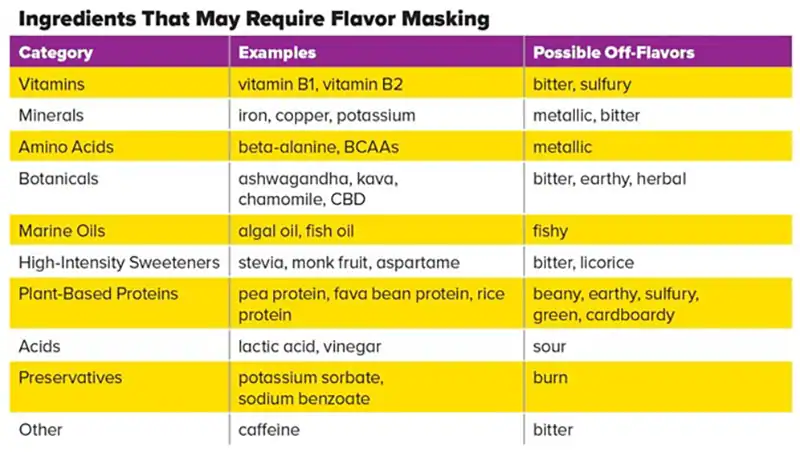
Table showing ingredients that may require flavor masking and their possible off-flavors, relevant to protein flavor planning.
The challenge extends well beyond protein. B vitamins can bring bitter or sulfury notes, minerals can contribute metallic or bitter characteristics, botanicals can introduce earthy or herbal notes, and high-intensity sweeteners can leave bitterness or licorice-like impressions. When several of these ingredients appear in the same formula, the flavor challenge becomes a balancing act across the entire system.
Soy: Lipoxygenase-derived aldehydes such as hexanal can create beany and nutty notes, while saponins can contribute bitter or soapy characteristics.
Pea: Bitterness and astringency can be significant considerations, although some nutty and grassy notes may work positively depending on the application.
Fava: Can offer fewer beany notes than some other plant proteins, but can still contribute bitter and astringent characteristics.
Potato: Can bring grainy, soily, acidic, astringent and bitter notes.
The usual fix is stepwise. Start by adjusting the basic tastes, then select a characterizing flavor that complements the off-note, and finally add a masking flavor if needed. Processing can help too, but the right flavor system is often critical to making the finished product taste intentional rather than simply trying to hide an undesirable note.
Where Protein Fits
Clear acidic beverages: Whey isolate is a strong fit because of its solubility in acidic systems, making it useful for clear, high-protein beverages.
Sports shakes and powders: Pea protein is widely used as a plant-based alternative to whey, casein and soy, but its characteristic flavor can require careful masking.
Dairy and frozen desserts: Dairy proteins remain a natural fit for these applications, where protein selection also affects texture, stability and the finished sensory profile.
Bars, baked goods and cereals: Plant proteins such as rice can work particularly well in solid applications where the format and flavor profile can help manage their characteristic notes.
Gelled and texture-driven products: Fava and mung proteins can offer useful functional properties, giving formulators additional options when texture and structure are important.
No single protein wins everywhere. The right choice depends on the application, pH, processing conditions, cost, nutritional goals and, increasingly, the flavor system needed to make the product taste great.
GLP-1s Change the Protein Equation
The rise of GLP-1 medications is adding another dimension to the conversation around protein. According to a recent Gallup Poll referenced by Dairy Foods, 11% of U.S. adults reported currently taking a GLP-1 medication for weight management in 2026, up from 3% in 2024. As use continues to grow, food and beverage companies have another consumer shift to consider: when appetite decreases and people eat less, the nutritional value of what they do choose becomes increasingly important.
Protein is particularly relevant because maintaining muscle mass is an important consideration during weight loss. This creates an opportunity for products that can deliver meaningful protein in convenient, appealing formats — from Greek yogurt and dairy beverages to protein shakes, bars, snacks and other everyday foods. But nutrition alone is not enough. When consumers are eating smaller amounts, there is even less room for a product that doesn’t taste good.
That makes the relationship between GLP-1s and protein more than a nutritional conversation. It is also a formulation and flavor challenge. Higher-protein products already require developers to manage notes such as bitterness, astringency, earthiness, beany characteristics and cardboard-like flavors, and those challenges become even more important when the goal is to create foods and beverages consumers will actively choose despite a reduced appetite.
For manufacturers, the growing GLP-1 market is another reason to think beyond the protein number on the label. The opportunity is to develop products that deliver protein and other important nutrients in formats that are convenient, enjoyable and easy to incorporate into changing eating habits — because when consumers are eating less, every bite and sip has to work harder.
That’s Where Flavor Comes In
Protein demand is not slowing down, and consumers are not going to lower their expectations for taste just because a product delivers more protein. The opportunity for formulators is to build products that deliver on both sides of the equation: the functionality consumers want and the flavor they actually enjoy.
That is where Jogue can help. Our masking agents are designed to address the challenging off-notes that can come with proteins and other functional ingredients, from bitterness and astringency to beany, earthy, sulfury and cardboard-like characteristics. Rather than simply covering up an off-flavor, the goal is to build a more balanced flavor system that works with the entire formula.
Whether it is a high-protein beverage, shake, bar, dairy product, bakery item or a completely new format, the right flavor and masking strategy can turn a technically successful protein product into one consumers actually want to drink or eat. As protein continues to move into more categories, making it taste great will be just as important as getting the protein number on the label.
A few weeks ago, the Jogue team headed to Chicago for IFT FIRST, joining food scientists, developers, ingredient suppliers and innovators from across the industry to explore what’s next for food and beverage.
The show floor was filled with new ingredients, technologies, research and product concepts, but some of the most valuable insights came from the conversations happening throughout the week, and thoughtful presentations. We left Chicago with new connections, fresh ideas and plenty to think about. A few themes in particular stood out.
Natural vs. Artificial: The Color Conversation Is Getting More Complicated
One of the most interesting conversations we had at IFT FIRST centered around artificial versus natural colors and flavors.
The answer isn’t as simple as “natural is better.” Consumer expectations can change depending on the product, the application and even the stage of life.
Younger consumers can be relatively accepting of artificial flavors and colors, but that perspective can shift when they become parents. Suddenly, the ingredients going into their children’s food receive much more scrutiny.
The application matters, too. Dairy tends to have a strong preference for natural colors, while confectionery has historically been somewhat more accepting of artificial colors. At the same time, certain synthetic colors have developed particularly negative reputations among American consumers, with Red 3 and Red 40 often at the center of the conversation.
That creates an interesting challenge for formulators: replacing an artificial color isn’t always as simple as finding a natural ingredient with a similar shade.
One of the more difficult challenges is achieving a natural blue in a clear liquid application—the kind of vibrant blue consumers might associate with a sports drink. Natural color solutions have to deliver the right shade while also standing up to the stability, processing and performance demands of the finished product. Natural color suppliers at IFT FIRST were showcasing technologies designed to address exactly these challenges.
The takeaway from Chicago? Color isn’t simply a question of natural versus artificial. It’s about understanding the consumer, the application and the technical demands of the product—and finding the right solution for all three.
From Snacking to “Smealing”: Food Has to Do More
Another theme that came through in Chicago was the continued blurring of the line between meals and snacks.
At its core, this shift is rooted in convenience. Consumers don’t always have the time to fit three traditional, well-rounded meals into their day. Instead, snacks are increasingly being asked to fill the gaps.
But convenience is only part of the equation. Health and wellness are raising expectations for what those eating occasions need to provide. If a snack is going to stand in for a meal, consumers want it to do more: provide protein, deliver fiber, support hydration, offer energy or contribute meaningful nutrition.
That helps explain why protein and fiber were such prominent themes at IFT FIRST. Industry coverage from the show highlighted the growing combination of protein and fiber as brands look to create more nutrient-dense foods and beverages. Protein is also continuing to move beyond traditional sports nutrition into mainstream products and everyday eating occasions.
So, will “smealing” still be around in 2030?
The name might not be. The idea almost certainly will.
Consumers will continue looking for foods that provide more functionality and nutrition in convenient formats. And as formulation technology improves, those nutritionally dense foods should become better tasting and better textured.
The future isn’t necessarily about adding more eating occasions. It’s about getting more out of the ones we already have.
Protein Is Getting Lighter
Protein was another major theme at IFT FIRST—but the conversation is changing.
The industry is moving beyond simply adding more grams of protein to a product. Developers are looking for ways to deliver protein in formats that feel lighter, more refreshing and more familiar.
Clear protein beverages are one example. The category has grown alongside demand for functional beverages, but formulators have historically faced challenges around clarity, solubility and taste. New ingredient technologies are beginning to make those formats more viable.
This fits into the broader shift toward functional foods that fit naturally into everyday life. Protein is no longer limited to bars, shakes and sports nutrition. It is showing up across beverages, snacks, bakery and other categories where consumers may not have traditionally expected it.
At the same time, the industry’s focus on protein is increasingly being paired with fiber and other nutritional benefits. The goal is becoming less about a single nutrient claim and more about creating products that provide meaningful nutrition in a convenient format.
AI Is Moving Closer to Food R&D
Artificial intelligence was also a major part of the IFT FIRST conversation.
IFT put AI front and center in its 2026 programming, focusing on how the technology can support product development, food safety, sustainability and R&D. The organization’s featured AI keynote specifically explored practical applications for making food innovation faster, smarter and safer.
What’s interesting is that the conversation around AI is becoming more practical. Instead of simply asking whether AI will change food science, the industry is increasingly asking where it can make food development more efficient and effective.
From formulation and ingredient selection to product optimization and R&D, AI is beginning to move from a futuristic concept toward a practical tool.
Turning Insights Into Innovation
IFT FIRST is always a great reminder of how quickly consumer preferences, technology and food science continue to evolve.
This year’s show made one thing especially clear: consumers want products that are convenient, functional, recognizable and enjoyable—but delivering all of those things at once requires serious formulation expertise.
Thank you to everyone who stopped by the Jogue booth, met with us over a meal, experienced some of the flavors we were showcasing or simply shared an idea with our team.
We left Chicago with new connections, fresh ideas and a renewed sense of where the industry is headed.
And now we’re bringing those insights back to our team and our customers—because the most interesting part of IFT FIRST isn’t simply seeing what’s new.
Consumers aren’t just eating and drinking anymore, they’re self-medicating, one flavor at a time. People are clamoring for products that do double duty: taste good and do something. Calm them down. Wake them up. Sharpen their focus. Fix their gut. Clear their skin. The catch is that nobody wants to choke down a chalky capsule or a clinical-tasting shot to get there. So brands have gotten clever about it, layering real functional benefits (energy, focus, immunity, collagen, detox) into formats that already feel like a treat: a fruity hydration packet, a candy-colored gummy, a protein water that tastes like dessert. The flavor is the delivery mechanism, and increasingly, it’s also the marketing hook.
Hydration Gets a Job Description
Nowhere is this pairing strategy more obvious than with hydration packets. Fruit-forward flavor is still the baseline, and brands are leaning on exotic notes like acai, guava, seaberry, and yuzu, and comfort-zone classics like strawberry, raspberry, and watermelon, with dessert- and mocktail-inspired flavors picking up steam on top of that. The real trend is what hydration gets paired with. Liquid I.V. built an entire flavor matrix around it, splitting its lineup into Hydration Multiplier, Sugar-Free, Kids, and functional sub-lines like Hydration Multiplier + Immune Support (Mango Passionfruit, Tangerine, Wild Berry Blend) and Hydration Multiplier + Energy (Blackberry Peach, Mango Tamarind, Yuzu Pineapple). Pedialyte has repositioned from sick-kid staple to adult recovery brand with an Immune Support line in Mixed Berry and Fruit Punch. Ultima pairs zero-sugar hydration with Daily Focus (Acai Blueberry), Collagen Defense (Kiwi Strawberry), Crave Killer (Tropical Fusion), and Gut Health (Raspberry Lemonade), plus a mocktail line that plays into sober-curious lifestyle branding. TruLabs stacks hydration with Detox, Organic Greens, and two Sleep formulas (Honey Lemon and Strawberry Hibiscus). Gatorade now runs Immune Support flavors inside its Zero Sugar line (Orange Raspberry, Lemon Blackberry) alongside a “Relax” hydration booster flavor. And Hydralyte may be the most functionally loaded of the bunch, pairing hydration with Brain Support (Mango Punch), Liver Support (three flavors, all built around ginger), Metabolic Support (Blood Orange), and Collagen — squarely targeting 30- to 50-somethings who treat hydration as preventative medicine rather than a post-workout afterthought. Add in AdvoCare’s gut-health line, Salud’s culturally-rooted Calm & Sleep and Energy & Focus flavors, and Klar Labs’ energy-plus-focus drink mix, and the pattern is impossible to miss: hydration is no longer the whole pitch, it’s the vehicle for something else.
Trending flavors in this space right now: guava, seaberry, yuzu pineapple, mango passionfruit, blood orange ginger, pina colada, and strawberry hibiscus, anything that can carry an exotic or dessert note while still reading as “clean.”
Gummies, Capsules, and the Rise of Supplements You Actually Want to Take
The bigger shift in the supplement aisle is format, not just flavor. Pills are losing ground to gummies because gummies solve the oldest problem in the category: nobody enjoys taking their vitamins. That shift is showing up directly in behavior, 35% of cognitive-health consumers had eaten candy and 42% had eaten gummies specifically, a sign of just how far the line between “supplement” and “snack” has blurred, especially in categories like focus and mood where consumers want the benefit without the medicinal feel (Kyowa Hakko, survey of cognitive health consumers, 2025).
OLLY has arguably the deepest bench, splitting its whole catalog by mental and physical need state: Goodbye Stress (GABA, L-theanine, lemon balm in a Berry Verbena flavor) for daytime calm, Sleep and Extra Strength Sleep (melatonin, L-theanine, chamomile) in Blackberry Zen, Sleep Immunity (melatonin plus vitamin C, zinc, echinacea) in Berry, Muscle Recovery Sleep (melatonin, tart cherry, vitamin D) in an Acai-Strawberry-Raspberry-Pomegranate blend, Hello Happy mood-support gummies in Tropical Zing, and Relaxing Magnesium in Raspberry Lavender — plus an Ultra Strength Brain softgel (bacopa, blueberry extract, omega-3s, B6/B12) for cognitive support. Goli built its entire brand on masking function-forward actives: its original Apple Cider Vinegar gummies (“Taste the Apple. Not the Vinegar.”) pair ACV with B9/B12 for metabolic and gut support, its Ashwa gummies lean on KSM-66 ashwagandha and vitamin D for stress and sleep, its Superfruits line packs acai, acerola, amla, pomegranate, and goji into a Strawberry Raspberry Watermelon flavor for immunity and skin, and its Sleep gummies combine lemon balm, magnesium, vitamin D, and melatonin. Vitafusion plays the mass-market fusion angle directly in its naming — its bestselling Multi+Immune Support is a bilayer gummy that fuses a daily multivitamin with vitamin C and zinc in a Tangerine-Strawberry flavor, alongside standalone Power C, Vitamin D, Power Zinc, and sleep formulas. SmartyPants targets the whole household with functional sub-lines — Sugar Free Multi & Omegas (D3 for immune support), Sugar Free Prenatal Multi & Omegas (lemon), Kids Sleep with melatonin, and picky-eater-friendly Kids Multi & Omegas in strawberry banana. Even legacy players are chasing the same benefit-pairing playbook: Nature Made’s Wellblends ImmuneMAX combines vitamin C, zinc, and D3 in Tangerine, and Nature’s Bounty’s Women’s Multivitamin pairs general and bone health support with Mixed Berry and Raspberry.
On the daily-use side, the supplement aisle overall still skews toward the basics — multivitamins remain the single most common supplement Americans take, followed by standalone vitamin D, magnesium, omega-3s, and probiotics, with collagen and adaptogens like ashwagandha among the fastest-growing add-ons as people build out more personalized, multi-product routines rather than relying on one all-in-one pill.
Flavor-wise, the gummy world splits into two camps. One is function-driven: citrus and orange/tangerine notes for vitamin C and immune gummies, tropical and “bright, uplifting” flavors for mood and energy, and botanicals like chamomile, lemon balm, and tart cherry creeping into sleep gummies. The other is pure confectionery nostalgia: berry remains the best-selling gummy flavor family overall, blue raspberry and sour/tart profiles (tart apple, sour berry blends) skew younger, and cocktail-inspired and globally-influenced fruit flavors (think passionfruit, dragon fruit, guava) are the ones brands use to signal premium or limited-edition status.
Trending flavors here: Berry blends, blue raspberry, tropical/citrus combos for immune and energy gummies, and cocktail-inspired or globally-sourced fruit flavors for premium positioning.
Water + Protein: The Category Protein Forgot It Needed
Protein as a standalone pitch is a little tired, bars are up 6.8%, sports powders up 7.2%, and ready-to-drink protein products up 7.4% year over year, according to Fonterra’s read on the US protein market. Roughly 6% of consumers already drink protein water, sparkling protein water, or protein-fortified carbonated drinks (Numerator) and that number is pulling in new entrants fast.
The pitch is simple: get your protein and your hydration in the same clear, light, refreshing package instead of a heavy, chalky shake. Wet Hydration added Passion Guava and Pineapple Whip Colada to its Protein Water line. Isopure Protein Water packs 15g of ultra-filtered protein plus electrolytes into Mixed Berry, Strawberry Kiwi, and Unflavored variants. Bloom Nutrition’s Bloom Clear Protein uses clear whey isolate and grass-fed collagen peptides for 20g of protein, sold exclusively at Target in Strawberry Watermelon and Raspberry Lemon. Kroger’s private-label Simple Truth Protein + Electrolyte Water Enhancers combine whey isolate and coconut water for 9g of protein in Mango Passionfruit and Strawberries and Cream. And PepsiCo’s Propel Clear Protein — a flavored powder mix with added electrolytes and fiber — is explicitly targeting GLP-1 medication users who need easier ways to hit their protein goals without heavy food.
Trending flavors: Passion Guava, Pineapple Whip Colada, Strawberry Watermelon, Raspberry Lemon, Mango Passionfruit, and Strawberries and Cream — all lighter, fruitier, and more “water” than “shake,” which is exactly the point.
Making Function Taste Good
Adding vitamins, botanical adaptogens, or clear proteins to your product is a great way to catch a consumer’s eye, but it usually comes with a catch: off-notes. Whether it’s the stubborn bitterness of a brain-boosting herb or the astringent edge of a clear protein isolate, getting these functional ingredients to taste great is tough.
That is exactly where Jogue comes in. We help your team tackle these formulation hurdles without overcomplicating your label. Our masking technologies block unwanted bitterness at the source, while our sweetness enhancers clean up the overall profile and improve mouthfeel. We stay on top of the latest flavor shifts so you can focus on the active benefits, knowing the final product will taste exactly like something consumers actually want to eat or drink every day.
As temperatures rise, the flavor and food development sectors are entering their most competitive window of the year. This summer, major CPG players and quick-service innovators are utilizing high-impact product rollouts to target rapidly evolving regulatory baselines and an insatiable consumer appetite for multi-sensory experiences.
The Clean-Label “Glow Up”: Vibrancy via Natural Colors
The clean-label movement has accelerated as the food industry shifts away from synthetic dyes. Major brands are demonstrating that removing artificial color additives like Red 40, Yellow 5, and Blue 1 does not mean compromising on the saturated, eye-catching visual pop that drives impulse purchases.
Frito-Lay: Stripped synthetic dyes from its flagship snack line to launch Simply NKD, showcasing Doritos Simply NKD in Nacho Cheese and Cool Ranch, which maintain their signature bold flavor profile over a cleaner, “naked” corn chip matrix.
Welch’s Fruit Snacks: Reached a major corporate milestone by transitioning 100% of its product portfolio to dye-free formulas, leaning entirely on concentrated fruit and vegetable juices from grape, carrot, blueberry, and red pepper.
Kraft Heinz: Initiated a broad portfolio modernization strategy with the rollout of JELL-O Simply, a ready-to-eat gelatin and mix line made with real fruit juice and zero FD&C colors, paving the way for dye-free renovations across legacy lines like Kool-Aid.
Refreshers: Unique and Innovative Fruit Pairings
This lane pairs high-contrast visual aesthetics with complex, texturized fruit inclusions. Beverage and bakery lines are stacking vibrant botanical layers and popping pearls to make seasonal menus highly interactive and social-media-ready.
Starbucks: Headlined the summer menu with its Tropical Butterfly Refresher, layering guava, passionfruit, and popping mango-pineapple pearls beneath a vivid violet crown of butterfly pea flower tea.
Sonic Drive-In: Mirrored this texturized fruit approach with its Tropical Cream Slush, layering real pineapple pieces and coconut slush directly into vertical swirls of vanilla soft serve.
Dunkin’: Deployed its Cherry Lime Rickey Refresher, pairing a tart limeade base with deep black cherry flavor, and structurally extended the theme into the bakery case with a limited-edition Fruit Punch Donut.
The “Swicy” Frontier: Fruit-Forward Heat
Spicy-sweet (“swicy”) has matured into a foundational flavor profile, moving past basic hot honey into complex chili-citrus combinations. Confections and quick-service proteins are actively chasing the same demographic with slow-building, authentic heat matrices.
Hot Tamales & Skittles:Hot Tamales captured the movement with its fruit-forward Tropical Heat collection featuring Fiery Lime, Mango Chili, and Pineapple Picante, while Skittles Gummies Fuego brought a parallel chili-warmth profile to the chewy candy aisle.
Whataburger: Anchored the trend on the savory fast-food side with the return of the Hot Honey Whatachick’n Sandwich, coating crispy chicken in a sweet-and-spicy hot honey gloss to lock onto the dominant snack profile.
The “Newstalgia” Playbook: Co-Branded Collaborations
Cross-brand collaborations have become the default strategy for eliminating consumer trial risk on summer menus. By engineering trusted childhood sweet treats into modern formats, brands are maximizing immediate nostalgic appeal.
Taco Bell & Krispy Kreme:Taco Bell launched its highly anticipated Strawberry Cinnabon Delights, while Krispy Kreme dropped a co-branded Milk Bar assortment alongside a retro-themed Masters of the Universe collection.
Cold Stone Creamery: Fused two major snack brands into one premium base with its summer flagship Cookies ‘n’ Peanut Butter Ice Cream, utilizing real Oreo cookies and Reese’s Peanut Butter Cups.
Turning Trends Into Products
Navigating the complexity of today’s seasonal launches requires precise flavor execution to keep products relevant and competitive. Jogue stays at the forefront of these market shifts, translating emerging trends into the technical formulations and collaborative partnerships your team needs to bring your vision to life and ensure a successful product launch.
The IDFA Ice Cream & Cultured Innovation Conference is always a highlight for connecting with the industry’s brightest. Beyond the usual networking and samples, the pace of innovation hitting the freezer aisle is unmistakable. It’s moving fast enough to give anyone a brain freeze.
Why Dairy Still Owns the Nutrition Label
While the market has spent years chasing alternatives, dairy is quietly reinforcing its role as the most effective functional base in the category. Protein remains the primary driver of consumer choice, but not all protein performs the same.
That’s where the Digestible Indispensable Amino Acid Score (DIAAS) comes in. It measures how efficiently the body can actually use protein, and dairy consistently outperforms plant-based sources like soy, pea, and wheat. This isn’t just about hitting a number on the label, it’s about real absorption and real performance.
Innovative brands are leaning into that advantage to build new formats:
Smearcase: This brand is flipping the script by using cottage cheese as the base for its frozen dairy dessert. The result is a product with half the fat and seven times the protein of traditional ice cream, proving that you don’t need powders to achieve high-performance nutrition.
Devin’s Foods: Their Real Living Yogurt line uses A2 milk and a 36-hour culturing process to deliver 300 times more probiotics than standard yogurt. With targeted varieties like “Good Gut,” “Good Glow,” and “Good Mood,” they are successfully pairing the protein benefit with prebiotic fiber and functional probiotics.
The Trend Map: Tracking Every Ice Cream Competition Concept
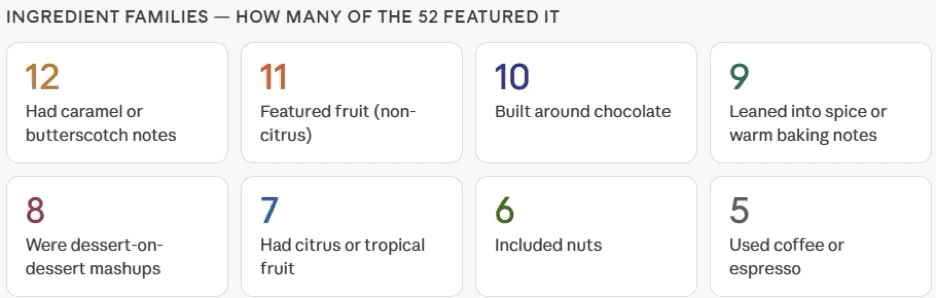
We tracked 52 featured entries during the conference tasting competition, from global giants to middle-market innovators. We paired together different flavors and trends to show which flavors were the most popular:
Featured Concept: Tropic Like It’s Hot
We brought our own perspective to the competition this year with Tropic Like It’s Hot.
This concept features a creamy coconut-based ice cream paired with a hot apricot variegate and cheesecake pieces. By borrowing from the sweet-heat trends and dessert-inspired mashups seen across the show floor, we created a profile that feels both familiar and entirely distinct, the kind of flavor that stands out in a crowded case.
From Lab to Freezer: How We Can Help
The insights from IDFA are clear: consumers want more from their dairy, and they want it in flavors they haven’t seen before. We’ve already completed the heavy lifting on prototyping for the next generation of bases and variegates.
Come visit the office, spend time in our R&D lab to work with us in real time. Whether you need to fine-tune a new inclusion or balance the flavor impact of a functional base, we can make those tweaks on the fly. With quick lead times across the country, we are ready to help you turn these trends into your next best-seller.
What flavor challenges can we help you solve for your next launch?
The landscape of American social drinking is reaching a definitive turning point. According to data from NielsenIQ (NIQ), for the 52-week period concluding January 3, 2026, the U.S. off-premises beverage alcohol market experienced a 3.4% decline in total dollar sales, settling at $110 billion. This downward trend was felt across every major category:
Wine: This sector saw the most significant pullback, with total dollar sales dropping by 4.7%.
Beer, Flavored Malt Beverages (FMBs), Hard Cider, and Hard Seltzer: This combined group saw a collective decrease of 3.7%.
Spirits: While more resilient than other categories, spirits still experienced a 1.8% decline in dollar sales.
The Macro-Efficiency Mindset
This decline isn’t just about moderation; it’s about a fundamental shift in how consumers value their metabolic “investments.” Today’s consumer is focused on macro-efficiency, meticulously tracking protein, fiber, and sugar to ensure every calorie serves a purpose. This trend has obviously hit the food industry, being the undisputed star of Expo West 2026.
Alcohol is commonly referred to as “empty calories,” being as calorie dense as pure fat while offering zero nutritional value. While breaking down alcohol, your body stops burning fat and carbs from your food, hitting a “pause” button on metabolism (USDA). People are less willing to trade a week of disciplined, nutrient-dense eating for a single night that effectively stalls their metabolic progress.
The Sophistication of NA Options
IWSR reported that no-alcohol spirits volume grew by 19% in the U.S. in the first half of 2025 alone. We are seeing a move away from simple “soda with a lime” toward high-fidelity mocktails that use:
Botanicals & Botanicals & Adaptogens: Ingredients like ashwagandha or L-theanine provide a functional “lift” or relaxation without the cognitive fog of ethanol.
Complex Flavor Profiles: Trending 2026 flavors like Blackberry Sage, Blood Orange Elderflower, and Smoked Pineapple are being used to replicate the depth and “bite” typically provided by spirits.
Zero-Proof Spirits: Replicas of gin and bourbon that focus on the “burn” of capsicum or ginger to satisfy the sensory memory of a drink.
Socializing Without the Proof
The social element of drinking remains essential, but the “liquid in hand” is changing. People like socializing with a drink in their hand, regardless of alcohol content.
The “Dirty Soda” Craze: Popularized by the viral hit Secret Lives of Mormon Wives, the company Swig has created massive buzz around “dirty sodas”—customizable drinks featuring soda bases mixed with cream, fruit, and flavored syrups. It provides a “vice” and a communal ritual that replaces the cocktail hour with a customizable, nostalgic experience.
Electrolyte & Functional Waters: Hydration is no longer just about quenching thirst—it’s about performance and daily wellness. Enhanced waters with minerals and vitamins are becoming go-to “social drinks,” offering a clean, refreshing alternative that still feels intentional in-hand.
Modern Functional Sodas: Functional sodas like Olipop and Poppi have redefined the category, reaching over $1 billion in combined retail sales last year. Pepsi’s $2 billion acquisition of Poppi confirms that the “Modern Soda” set—which offers gut health and low sugar—is the new social currency.
Sparkling Tea & Elevated RTD Teas: Positioned as a wine alternative, sparkling teas offer tannins, complexity, and flavor layering—delivering a more elevated sipping experience that fits seamlessly into social rituals.
The “Mocktail” isn’t just a drink anymore—it’s a flavor profile that is migrating into the broader functional world. Consumers want the sophistication of a bar program in their daily wellness routines.
Mocktail-Inspired Hydration: Brands are moving beyond basic fruit flavors into true mixology. Liquid I.V. launched “Mixologist-Crafted” packs like Smoky Mezcal Paloma, while Ultima Replenisher released a “Mocktini” variety pack featuring Peach Bellini and Coconut Piña Colada.
Clear Protein “Spritzers“: The “Clear Whey” revolution allows protein to mimic cocktails rather than milkshakes. Brands like Ghost Lifestyle and MyProtein use Mango Margarita or Yuzu Pineapple isolates to provide a crisp, refreshing drink that delivers 25g of protein with zero sugar.
Functional Social Gummies: The new “Social Gummy” category replaces the nightcap. Brands like Melt-to-Make™ and Mule CBD offer Moscow Mule and Raspberry Spritzer profiles infused with adaptogens like Ashwagandha to provide a “natural chill” during social gatherings.
How Jogue Can Help
As the line between beverage, supplement, and social ritual continues to blur, the demand for high-quality flavor solutions has never been higher. Whether it’s a social soda or a recovery shot, the flavor must be as functional as the ingredients. At Jogue, we can help you:
Replicate the “Ethanol Bite”: Developing complex botanical and spice blends that provide the sensory “kick” of alcohol in NA spirits.
Clean-Label Functional Masking: Using our expertise to mask the off-notes of high-dose proteins, fibers, and adaptogens in prebiotic sodas and powders.
Trend-Driven Development: We bridge the gap between “what’s trending” and “what’s possible,” helping you formulate and launch the next generation of social beverages using 2026’s most coveted flavor profiles.
We use cookies on our website to give you the most relevant experience by remembering your preferences and repeat visits. By clicking “Accept”, you consent to the use of ALL the cookies.
This website uses cookies to improve your experience while you navigate through the website. Out of these, the cookies that are categorized as necessary are stored on your browser as they are essential for the working of basic functionalities of the website. We also use third-party cookies that help us analyze and understand how you use this website. These cookies will be stored in your browser only with your consent. You also have the option to opt-out of these cookies. But opting out of some of these cookies may affect your browsing experience.
Necessary cookies are absolutely essential for the website to function properly. This category only includes cookies that ensures basic functionalities and security features of the website. These cookies do not store any personal information.
Any cookies that may not be particularly necessary for the website to function and is used specifically to collect user personal data via analytics, ads, other embedded contents are termed as non-necessary cookies. It is mandatory to procure user consent prior to running these cookies on your website.

Recent Comments